
when will 8th pay commission come. If you’re a central government employee or pensioner, chances are the 8th Pay Commission is the one topic you’ve been tracking very closely. And honestly, who can blame you? A pay revision that could mean a 30–40% salary hike is a big deal. But with so much noise on social media and half-baked information floating around, it’s hard to know what’s actually true.
So let’s cut through the confusion and give you a clear, honest picture of where things stand right now, and what you can realistically expect going forward.
What Is the 8th Pay Commission?
The 8th Central Pay Commission (8th CPC) is a government-appointed body tasked with reviewing and revising the salaries, allowances, and pensions of central government employees and pensioners across India. Think of it as a salary review committee — except it covers over one crore (10 million) government workers and retirees at once.
India has a tradition of setting up a new Pay Commission roughly every 10 years. The 7th Pay Commission was implemented in 2016 and its cycle officially ends on December 31, 2025. The 8th CPC is its natural successor.
Also Read :- 8th Pay Commission Calculator
When Was the 8th Pay Commission Formed?
The Union Cabinet, chaired by Prime Minister Narendra Modi, gave the in-principle approval for the 8th Pay Commission back in January 2025. The commission was then formally constituted via Gazette Notification on November 3, 2025, and is headquartered at Chanderlok Building, Janpath, New Delhi.
The commission comprises:
- Chairperson — heads all operations
- Member (Part-Time) — provides expert advisory inputs
- Member-Secretary — handles research, documentation, and administration
So When Will the 8th Pay Commission Actually Come Into Effect?
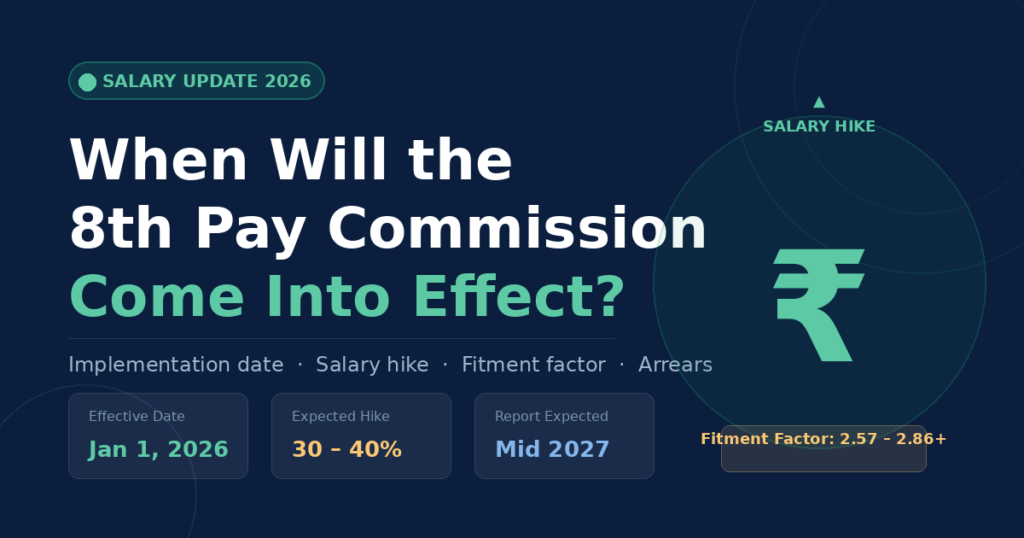
This is the question everyone’s asking — and the honest answer is: the official reference date is January 1, 2026, but actual revised salaries may not reach employees’ accounts until 2027.
Here’s why:
The Terms of Reference (ToR) approved by the Cabinet in October 2025 stated that recommendations are expected to take effect from January 1, 2026 — continuing India’s 10-year pay revision cycle. However, the commission has been given 18 months from its constitution date (November 3, 2025) to submit its final report, which puts the report submission deadline around mid-2027.
After the report is submitted, the government still needs to review, accept, and officially notify the revised pay structure. Based on past patterns, the actual implementation of revised salaries is likely to happen in late 2027 or early 2028.
But here’s the silver lining — January 1, 2026, will remain the effective date for arrears. So employees won’t lose out. They’ll receive a lump-sum arrear payment covering the gap between January 2026 and the actual implementation date.
What’s Happening Right Now? (May 2026 Update)
The 8th Pay Commission is currently in the active consultation and data-gathering phase. Here’s what’s been happening:
- Public consultation via MyGov portal — The government launched an 18-point questionnaire for public feedback. The feedback window closed on March 31, 2026.
- Field visits underway — The Commission has been conducting regional visits across India to gather stakeholder inputs, including interactions in Delhi (April 28–29), Pune (May 4–5), and Dehradun (April 24).
- NC-JCM memorandum deadline extended — The National Council (JCM) Staff Side has been granted a deadline extension to May 31, 2026 for submitting their comprehensive demands memorandum.
- DA hike notified — Separately, the Union Cabinet approved a 2% Dearness Allowance hike, effective January 1, 2026, raising DA from 58% to 60% of basic pay.
The focus right now is on collecting data on pay structures, inflation patterns, cost of living trends, and employee demands before the commission begins drafting its final recommendations.
Expected Salary Hike: What Are the Numbers?
Let’s talk about the part you’re most curious about — how much will salaries actually increase?
The Fitment Factor
The fitment factor is essentially a multiplier applied to your current basic pay to arrive at the revised salary. The 7th Pay Commission used a fitment factor of 2.57, which translated to a roughly 14–23% salary hike.
For the 8th Pay Commission:
- Employee unions are demanding a fitment factor between 2.86 and 3.68
- Most analysts project a factor between 2.57 and 2.86
- A fitment factor of 2.86 could mean a 25–35% increase in take-home salary
Minimum Basic Pay
If a fitment factor of 2.86 is approved, the minimum basic pay is expected to jump from the current ₹18,000 to approximately ₹51,480. Employee unions are demanding this go even higher.
DA Merger Boost
Here’s something many people miss — at the time of implementation, Dearness Allowance (currently at 60%) is expected to be merged into basic pay, similar to what happened with the 6th Pay Commission. This means the actual effective base for calculating HRA, gratuity, pension, and arrears will be significantly higher than just the fitment factor suggests.
What About Pensioners?
Pensioners have every reason to be optimistic too. The 8th CPC is expected to bring:
- Minimum pension likely to rise from ₹9,000 to ₹20,000–₹25,740
- Dearness Relief (DR) will reset to zero and be recalculated on the revised pension base
- Gratuity ceiling likely to increase from the current ₹20 lakh
- Family pension revised upward using the new pay matrix
Over 35 lakh pensioners and family pensioners are expected to benefit from the revision.
What About Arrears?
Since there will inevitably be a gap between January 1, 2026 (the effective date) and the actual implementation date, employees will receive arrears — the difference between their old and new salary for every month in between.
Quick Example: If your new basic pay becomes ₹90,000 and your old basic pay was ₹30,000, and implementation happens 18 months after January 2026, your arrear would be:
(₹90,000 − ₹30,000) × 18 months = ₹10,80,000
For many employees, arrears could amount to ₹1 lakh to ₹15 lakh or more, depending on their pay level and the final fitment factor. However, remember these are projections. Official figures will depend entirely on the commission’s final recommendations.
8th Pay Commission vs 7th Pay Commission: Key Differences
| Parameter | 7th Pay Commission | 8th Pay Commission (Expected) |
|---|---|---|
| Effective Date | January 1, 2016 | January 1, 2026 |
| Fitment Factor | 2.57 | 2.57–2.86+ (projected) |
| Minimum Basic Pay | ₹18,000 | ₹51,480+ (projected) |
| DA at Implementation | ~125% | ~60% (to be merged) |
| Implementation Year | 2016 | 2027 (likely) |
Timeline: Key Milestones
| Date | Milestone |
|---|---|
| January 16, 2025 | Cabinet gives in-principle approval |
| October 28, 2025 | Terms of Reference approved by Cabinet |
| November 3, 2025 | 8th CPC formally constituted via Gazette Notification |
| January 1, 2026 | Reference date for salary revision / DA raised to 60% |
| March 31, 2026 | MyGov public consultation closes |
| April–May 2026 | Commission conducts regional field visits |
| May 31, 2026 | NC-JCM memorandum submission deadline |
| Mid-2027 (Expected) | Commission submits final report |
| Late 2027–Early 2028 (Expected) | Revised salaries implemented; arrears paid |
What Should You Do Right Now?
Here’s some practical advice while you wait:
- Don’t fall for viral WhatsApp messages promising specific implementation dates or salary figures. Always verify from official sources: 8cpc.gov.in or DoPT.
- Use online salary calculators to estimate your potential revised salary under different fitment factors — but treat these as projections, not guarantees.
- Plan your finances conservatively — don’t make major financial commitments based on expected arrears until official notifications are out.
- Stay updated through the official 8th CPC website and Ministry of Finance notifications.
Frequently Asked Questions (FAQs)
Q1. When will the 8th Pay Commission come into effect? The official reference date is January 1, 2026. However, based on the commission’s 18-month timeline for submitting its report, actual revised salaries are expected to reach employees’ accounts by late 2027 or 2028.
Q2. Has the 8th Pay Commission been officially approved? Yes. The 8th Central Pay Commission was formally constituted by the Government of India via Gazette Notification on November 3, 2025. The Terms of Reference were approved by the Union Cabinet on October 28, 2025.
Q3. Will I receive arrears if implementation is delayed? Yes. Since January 1, 2026, is the designated effective date, employees will receive arrears covering the full gap period from that date to the actual implementation date. These will likely be paid as a lump sum.
Q4. What is the expected fitment factor for the 8th Pay Commission? The fitment factor hasn’t been finalized yet. Employee unions are demanding between 2.86 and 3.68, while analysts project a more conservative range of 2.57 to 2.86. The 7th Pay Commission used 2.57.
Q5. What will happen to Dearness Allowance (DA) under the 8th Pay Commission? When the revised pay structure is implemented, the existing DA (currently at 60%) is expected to be merged with basic pay, and DA will reset to near zero under the new structure. This will significantly boost the base used for calculating all other allowances.
Q6. Will pensioners benefit from the 8th Pay Commission? Absolutely. Pensioners will see their pension revised using the new fitment factor. The minimum pension is expected to rise from ₹9,000 to ₹20,000 or more, and Dearness Relief will be reset and recalculated on the new pension base.
Q7. How many employees will benefit from the 8th Pay Commission? The 8th Pay Commission covers over 50 lakh central government employees and more than 35 lakh pensioners and family pensioners — a total of over 1 crore individuals.
Q8. Where can I find official updates on the 8th Pay Commission? The official website of the 8th Central Pay Commission is 8cpc.gov.in. You can also check the Department of Personnel & Training (DoPT) and the Ministry of Finance websites for official notifications.
Q9. Is there any interim relief expected before the final report? Some employee organizations, like FNPO, have formally requested a merger of 50% DA with basic pay as interim relief pending the final recommendations. However, no official announcement on interim relief has been made as of May 2026.
Q10. What is the difference between the reference date and the implementation date? The reference date (January 1, 2026) is the date from which revised pay will be calculated for the purpose of arrears. The implementation date is when employees actually start receiving their revised salaries — which is expected to be 2027 or later, after the commission submits its report and the government approves the recommendations.
The Bottom Line
The 8th Pay Commission is very much in motion — it’s been formally constituted, it’s actively consulting stakeholders, and it’s working toward its report. The good news is that January 1, 2026, is locked in as the effective date, so no one loses out on salary benefits due to procedural delays.
The realistic expectation is that revised salaries will hit accounts sometime in 2027, accompanied by a substantial lump-sum arrear payment. The exact amount will depend on the fitment factor the commission ultimately recommends — and that’s still being deliberated.
For now, stay patient, stay informed, and rely only on official sources. The wait will be worth it.
Last Updated: May 2026 | Sources: 8cpc.gov.in, Ministry of Finance, PIB India
For more details and recent updates on the 8th Pay Commission, refer to the official website of the Commission at: https://8cpc.gov.in/