
8th Pay Commission Salary Hike: Can Higher HRA, TA and DA Merger Raise Salary by 65%?
The 8th Pay Commission salary hike has once again become a major topic among central government employees. Fresh salary calculations suggest that a Level 1 employee could potentially see a sharp increase in gross monthly pay if demands related to the fitment factor, House Rent Allowance (HRA), Transport Allowance (TA) and Dearness Allowance (DA) are considered.
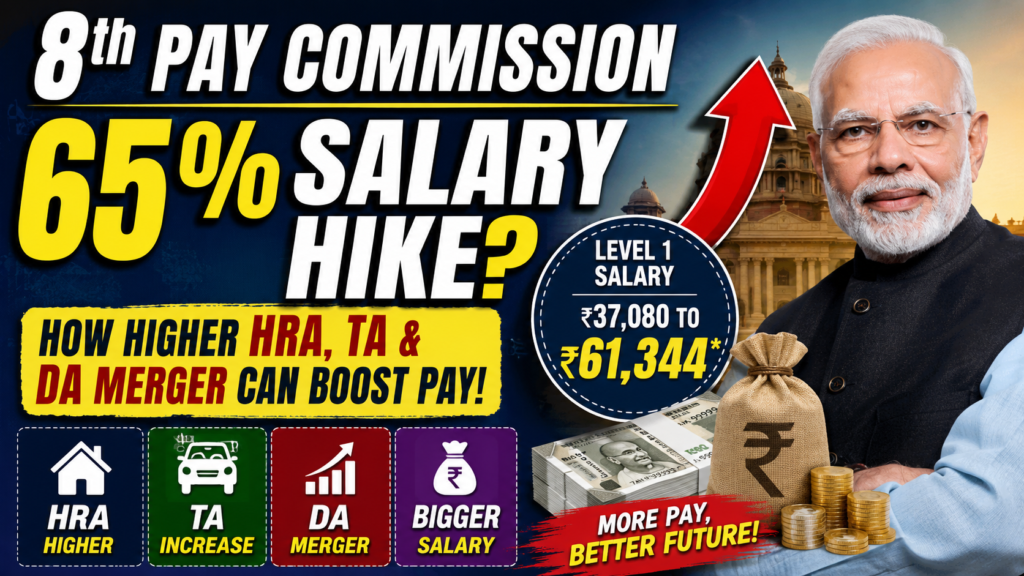
Under one proposed salary scenario, the gross monthly pay of a Level 1 central government employee may rise from around ₹37,080 to ₹61,344. This works out to an increase of nearly 65%.
However, employees should understand one crucial point: the 65% salary hike is not a final government announcement. It is an estimated calculation based on proposals and salary assumptions being discussed in connection with the 8th Central Pay Commission.
So, how can the salary reach ₹61,344? Here is a simple breakdown.
8th Pay Commission 65% Salary Hike: What Is the Latest Update?
Central government employee organisations have raised several demands regarding the future salary structure under the 8th Pay Commission.
The discussions are not limited to a higher basic salary. Employee representatives are also seeking changes in major salary components that directly affect gross monthly income.
The key proposals include:
- A higher fitment factor
- Revision of the family unit formula
- Higher House Rent Allowance or HRA
- Increased Transport Allowance or TA
- Merger of Dearness Allowance with basic pay
- Better inflation-linked salary protection
If multiple proposals are accepted together, the overall salary benefit could be much higher than an increase in basic pay alone.
This is the main reason the estimated 8th Pay Commission salary hike of up to 65% is attracting attention.
8th Pay Commission Fitment Factor Could Increase Basic Pay
The 8th Pay Commission fitment factor will be one of the most important elements in deciding the revised salary of central government employees.
A fitment factor is a multiplier used while calculating revised basic pay.
For example, if a Level 1 employee has a basic salary of ₹18,000 and a hypothetical fitment factor of 2.10 is applied, the calculation would be:
₹18,000 × 2.10 = ₹37,800
The revised basic pay in this simple illustration would therefore be ₹37,800.
However, the final fitment factor for the 8th Pay Commission will depend on the Commission’s recommendations and the government’s decision.
How Family Unit Changes May Affect the Fitment Factor
The family unit formula has also entered the salary debate.
The existing salary calculation framework has traditionally considered a standard family size while assessing minimum financial requirements. Employee representatives have argued that dependent parents and changing household expenses should receive greater weight.
One proposal seeks to increase the family unit calculation to 4.4 units.
Supporters of the proposal believe a larger family unit would provide a more realistic picture of food, housing, healthcare and other essential household expenses.
If the Commission adopts a revised family unit methodology, it may influence the minimum pay calculation and, indirectly, the fitment factor.
8th Pay Commission HRA Revision Could Boost Monthly Salary
The 8th Pay Commission HRA revision is another major issue for government employees, particularly those working in expensive cities.
House Rent Allowance is calculated as a percentage of basic pay. Therefore, an increase in basic salary can already raise the HRA amount.
If the HRA percentage is also revised, the monthly benefit could become even larger.
One proposal has suggested HRA rates of:
| City Category | Proposed HRA Rate |
|---|---|
| X Category City | 36% |
| Y Category City | 24% |
| Z Category City | 12% |
Some employee groups have demanded even higher HRA rates.
Why Are Employees Demanding Higher HRA Under 8th CPC?
Housing expenses have increased significantly in many urban areas.
Government employees posted in metro cities often spend a considerable part of their income on rent. The cost of accommodation, maintenance and basic household services can vary sharply between smaller towns and major cities.
Employee organisations therefore want the 8th Pay Commission HRA structure to better reflect present housing costs.
A higher revised basic pay combined with a higher HRA rate could substantially increase gross salary.
8th Pay Commission Transport Allowance May Also Increase
Transport expenses are another important part of an employee’s monthly budget.
The 8th Pay Commission Transport Allowance, also referred to in salary discussions as TPTA, may see major revision if employee demands are considered.
One proposal seeks a minimum transport allowance of around ₹9,000 for Level 1 employees.
Other recommendations have called for a significant increase in the existing transport allowance and a mechanism to protect the allowance against inflation.
Why Is Higher TA Being Demanded?
Daily travel costs have changed considerably over the years.
Employees may spend money on:
- Metro and local train travel
- Bus fares
- Fuel
- Auto and taxi services
- Last-mile transport
- Daily office commuting
These costs can be particularly high in metropolitan areas.
A revised 8th Pay Commission TA structure could therefore provide additional monthly relief to central government employees.
8th Pay Commission DA Merger: Can Dearness Allowance Be Added to Basic Pay?
The possible 8th Pay Commission DA merger is one of the most closely watched demands.
Dearness Allowance is provided to help employees manage the impact of inflation. DA is periodically revised according to the applicable government formula.
Employee organisations have argued that DA should be merged with basic pay after reaching a specified level.
How Can DA Merger Benefit Government Employees?
The biggest advantage of a DA merger is the creation of a higher salary base.
Several salary-related benefits are linked directly or indirectly to basic pay.
A higher basic pay may influence:
- House Rent Allowance
- Certain salary-linked allowances
- Retirement calculations under applicable rules
- Pension-related calculations for eligible employees
- Future salary revision calculations
For example, if an amount currently paid separately as DA becomes part of basic pay under a future approved salary structure, subsequent percentage-based calculations may operate on a higher base.
However, the actual treatment of DA under the 8th Pay Commission will depend on the final recommendations and government approval.
8th Pay Commission Salary Calculator: ₹37,080 to ₹61,344 Explained
The 8th Pay Commission salary calculation for a Level 1 employee can be understood through an estimated scenario.
Consider an employee posted in an X-category city.
Current Estimated Gross Salary
| Salary Component | Estimated Amount |
| Basic Pay | ₹18,000 |
| DA | ₹10,440 |
| HRA | ₹5,400 |
| Transport Allowance and Related DA | ₹3,240 |
| Estimated Gross Salary | ₹37,080 |
Now consider a proposed 8th CPC salary structure using a 2.10 fitment factor, revised HRA, higher transport allowance and a small DA component on revised basic pay.
Proposed 8th Pay Commission Salary Estimate
| Salary Component | Estimated Amount |
| Revised Basic Pay | ₹37,800 |
| HRA at 36% | ₹13,608 |
| Transport Allowance | ₹9,000 |
| DA at 2% | ₹756 |
| Other Calculation Adjustment | ₹180 |
| Estimated Gross Salary | ₹61,344 |
The exact salary structure may differ depending on the final pay matrix and allowance rules.
How Is the 65% Salary Hike Under 8th Pay Commission Calculated?
The estimated salary increase can be calculated using the difference between current and proposed gross salary.
Current estimated salary: ₹37,080
Proposed estimated salary: ₹61,344
The salary difference is:
₹61,344 – ₹37,080 = ₹24,264
Now calculate the percentage increase:
₹24,264 ÷ ₹37,080 × 100 = approximately 65.4%
Therefore, under this hypothetical salary scenario, the Level 1 employee’s gross monthly salary could increase by around 65%.
The annual gross salary difference could be approximately:
₹24,264 × 12 = ₹2,91,168
This means the employee may receive nearly ₹2.91 lakh more in annual gross salary under the estimated scenario.
Again, this is a projection based on multiple assumptions and should not be treated as a confirmed salary revision.
8th Pay Commission Salary Hike: Why Allowances Matter More Than Expected
Many employees focus only on the 8th Pay Commission fitment factor when estimating their future salary.
However, the final increase in gross salary may depend on several components working together.
Suppose the government approves a moderate fitment factor but significantly revises HRA and Transport Allowance. In that situation, the employee’s gross salary may still see a substantial increase.
Similarly, a high fitment factor without major allowance revisions may produce a different in-hand salary result.
This is why employees should examine the complete salary structure instead of looking only at revised basic pay.
Is the 8th Pay Commission 65% Salary Hike Confirmed?
No. The 8th Pay Commission 65% salary hike is not confirmed.
The salary figures being discussed are based on proposals, demands and estimated calculations.
The final salary revision will depend on several factors, including:
- Final fitment factor
- New pay matrix
- Minimum pay calculation
- HRA rates
- Transport Allowance rates
- Treatment of Dearness Allowance
- Other allowance revisions
- Government acceptance of the Commission’s recommendations
Until the final recommendations and implementation decisions are announced, employees should treat salary figures such as ₹61,344 as estimates rather than guaranteed pay.
What Could Level 1 Employees Expect From the 8th Pay Commission?
Level 1 employees may be among the key beneficiaries if the minimum salary and allowance structure receives a major revision.
A change in the minimum basic pay can have a cascading effect on the salary structure.
Higher basic pay may result in a higher HRA amount, while a revised Transport Allowance could further increase monthly gross earnings.
The final impact will also depend on the employee’s posting city, pay level, applicable allowances and deductions.
Therefore, two employees at the same pay level may not necessarily receive the same in-hand salary.
8th Pay Commission Latest News: What Should Employees Watch Next?
Central government employees should closely watch developments related to the 8th Pay Commission recommendations and salary structure.
The most important announcements will concern the fitment factor, pay matrix, minimum basic pay and revised allowances.
Employees should particularly track:
- 8th Pay Commission fitment factor announcement
- Revised minimum basic salary
- New pay matrix
- HRA revision
- Transport Allowance revision
- DA treatment or merger rules
- Pension revision
- Government approval and implementation orders
Any official decision on these areas could significantly change current salary estimates.
Frequently Asked Questions on 8th Pay Commission Salary Hike
Will salary increase by 65% under the 8th Pay Commission?
A 65% salary increase is an estimated scenario based on proposed changes to basic pay, HRA, Transport Allowance and DA. It has not been confirmed as the final salary hike.
What could be the Level 1 salary under the 8th Pay Commission?
Under one estimated calculation, the gross salary of a Level 1 employee may increase from around ₹37,080 to approximately ₹61,344. The actual salary will depend on final government-approved rules.
What is the expected 8th Pay Commission fitment factor?
Different fitment factor estimates and demands are being discussed. The final multiplier will be known only after the Commission’s recommendations and government approval.
Will DA merge with basic pay under the 8th Pay Commission?
Employee organisations have raised demands related to DA merger. However, the final DA treatment will depend on the approved 8th Pay Commission salary structure.
Will HRA increase in the 8th Pay Commission?
Higher HRA rates have been proposed by employee bodies. The final rates for X, Y and Z category cities have not yet been approved.
Can Transport Allowance increase to ₹9,000?
A ₹9,000 transport allowance has appeared in a proposal for Level 1 employees. It should be treated as a demand or estimated salary component until officially approved.
Conclusion
The 8th Pay Commission salary hike could bring a major change in the earnings of central government employees if proposals related to the fitment factor, HRA, Transport Allowance and DA are accepted.
An estimated salary calculation shows that a Level 1 employee’s gross monthly pay could potentially rise from ₹37,080 to ₹61,344, representing an increase of nearly 65%.
However, the projected increase depends on several assumptions. The 65% hike is not an officially confirmed salary revision.
The final impact of the 8th Pay Commission will become clearer only after decisions on the fitment factor, pay matrix, HRA, TA and DA structure are finalised.
Central government employees and pensioners should therefore follow official 8th Pay Commission announcements before treating any estimated salary figure as final.